

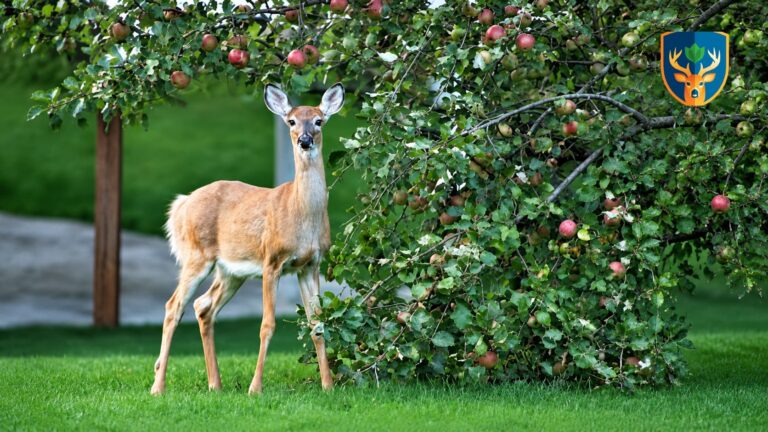
Yes, deer eat apples, and they also browse the buds, new growth, and foliage of apple trees.
Penn State Extension notes that deer browse dormant terminal buds and new growth on fruit trees, and the University of Kentucky’s fruit scouting guide describes deer feeding on young shoots and foliage. Deer browse many common landscape plants, including apple trees.
Iowa State Extension lists apples among the fruits and vegetables frequently damaged by deer, and on fruit plantings in general, Penn State Extension notes that deer may eat ripening fruit in summer and keep eating fruit in autumn.
Deer can harm the tree itself as well, from browsed buds to bark stripped by bucks rubbing their antlers. Here is why apple trees draw deer, how fruit and bark damage differ, which trees face the most risk, and how to protect them.
Why Apple Trees Are a Top Deer Target
Apple trees draw deer because they offer food deer favor across most of the year: tender buds and shoots in spring, ripening fruit from summer through fall, and bark bucks target when rubbing antlers. Iowa State Extension lists apples among the fruits and vegetables frequently damaged by deer, and crabapples among the trees and shrubs frequently damaged.
Where a tree grows plays a part. The University of California’s IPM program names apple trees, along with roses, among the highly palatable plants that draw deer when planted around homes in California, where such plants can be badly damaged.
Season matters too. Penn State Extension notes that from late summer to early winter, fruits and nuts make up a large part of a deer’s diet. Deer also feed on the young shoots and foliage of apple trees, according to the University of Kentucky’s fruit scouting guide.
Apple trees are one of many plants deer go after, and our plant-by-plant deer guides cover what deer favor across the rest of a landscape.
Fruit vs. Bark Damage: What to Look For
Deer damage apple trees in two ways: by browsing buds and shoots, and by bucks rubbing their antlers against trunks and limbs.
Browsing Damage to Buds, Shoots, and Fruit
On fruit plantings, Penn State Extension notes that deer may browse new growth and eat ripening fruit in spring and summer, and may keep eating fruit in autumn. The most serious damage comes in winter, Penn State adds, when browsing of buds can stunt young trees and lower fruit yields on dwarf trees.
Browsed twigs look torn and jagged, because deer have no upper incisors, while rabbits and rodents clip stems neatly at about a 45-degree angle, according to University of Maryland Extension. Deer also rarely leave tooth marks in bark, University of Minnesota Extension notes.
Antler Rubbing Damage to Bark
In fall, bucks rub their antlers on small trees to shed dried velvet, which strips the thin bark, usually 1.5 to 3.5 feet above the ground, according to Iowa State Extension. Look for vertical scrapes and shredded bark on saplings, trunks, and limbs, the signs University of Maryland Extension describes.
Rubbing can break limbs and girdle the trunk, Penn State Extension notes, and enough bark loss can kill the tree, according to Penn State’s orchard wildlife guide. University of Minnesota Extension adds that rubbing damage can be worse than browsing.
Backyard Apple Trees vs. Orchards: Different Risk Levels
Backyard apple trees and orchard trees can face the same basic browsing and rubbing damage, but the homeowner decision here is how to protect a residential tree without treating an orchard or fruit.
Young, dwarf, and semidwarf apple trees face the most risk because most of the tree sits within a deer’s reach, according to Penn State Extension. Penn State describes deer damage in both its home fruit planting guide and its orchard wildlife guide.
Surroundings matter as well:
- Woods nearby. Deer are abundant where field crops and orchards are mixed with forest, Penn State notes.
- Trees beside the house. Apple trees planted around homes draw deer, according to the UC IPM program in California.
- Habit. Deer return to the same feeding area habitually, moving in before sunset and out before dawn, Penn State Extension notes.
- Season. Bucks rub their antlers on small trees in fall, according to Iowa State Extension, and the most serious browsing comes in winter, according to Penn State Extension, so young trees are worth watching through both seasons.
How to Protect Apple Trees from Deer
Protecting apple trees starts with guarding young trunks before fall, clearing away fallen fruit, and setting realistic expectations for repellents.
- Guard young trunks. University of Minnesota Extension advises having tree guards in place from August through December against rubbing, and Iowa State Extension notes that stakes or posts set around each tree in late summer can prevent it. Tree protectors such as wraps, tubes, or wire cylinders work, according to University of Maryland Extension.
- Know what repellents can and cannot do. Repellents do not work against antler rubbing, University of Maryland Extension notes. For browsing, repellents reduce damage rather than ending it and need reapplying, according to Penn State Extension and University of Minnesota Extension.
- Clear away fallen fruit. UNL’s Backyard Farmer lists fallen fruit first among the foods to clear away so fewer things draw deer.
- Leave feeding out of the plan. UNH Extension, with New Hampshire Fish and Game, urges landowners not to feed deer, noting that feed sites concentrate deer and lead to over-browsing of ornamental plants, and University of Minnesota Extension also advises against feeding deer.
- Consider fencing where pressure is heavy. Fencing is the most efficient way to reduce damage where deer are numerous, and damage is extensive, according to Penn State Extension. A fence is a bigger project, and it needs ongoing upkeep to keep working.
Our service covers ornamental landscaping and apple trees up to fruiting, not orchards or fruit. Within that limit, professional protection means recurring treatments built around your property, so the ornamental plantings around your home are looked after through the year.
How Deer Solution® Helps Protect Your Landscape
Deer Solution helps protect your landscape with a recurring professional repellent service built around your property.
Your local Deer Solution team combines Certified Deer Damage Expert® expertise, highly trained technicians, proprietary liquid and granular repellents, and ongoing support to build a treatment program around your property and deer pressure.
A recurring treatment program covers the ornamental shrubs, flowers, and beds around an apple tree.
The repellent is all-natural, formulated with essential oils and other natural ingredients, and relies on taste and smell rather than a barrier to discourage browsing. It dries clear, carries no foul odor once set, and is rain-fast once dry.
Your local team builds the treatment program around your property, your plantings, and current deer pressure, then revisits it with you as conditions change. No repellent makes a tree or plant untouchable, and no service can promise deer will stay out of the yard for good.
Frequently Asked Questions About Deer and Apples
Do deer eat fallen apples off the ground?
Fallen apples can draw deer. UNL’s Backyard Farmer lists fallen fruit first among the foods to clear away so fewer things attract deer, and on fruit plantings, Penn State Extension notes that deer may keep eating fruit in autumn.
Do deer damage apple tree bark, not just fruit?
Yes. In fall, bucks rub their antlers on small trees to shed dried velvet, stripping thin bark, according to Iowa State Extension. Enough bark loss can kill the tree, Penn State’s orchard wildlife guide notes.
Which other fruit trees do deer damage?
Deer’s favorite fruit trees besides apples include cherries and plums, which Iowa State Extension lists among the fruits deer frequently damage, with pears rated as occasionally damaged. Rutgers rates sweet cherry and common pear as occasionally severely damaged.
Do deer damage backyard apple trees the same way as orchard trees?
Penn State Extension gives the same description of deer damage in its home fruit planting guide and its orchard wildlife guide, with young, dwarf, and semidwarf trees most at risk. Your local Deer Solution team serves ornamental landscaping and apple trees up to fruiting, not orchards.
Talk to a Certified Deer Damage Expert About Your Landscape
Protect the ornamental shrubs, flowers, and beds around your apple tree. Schedule a Free Consultation, find your local Deer Solution team, or call (888) 503-8313.


