



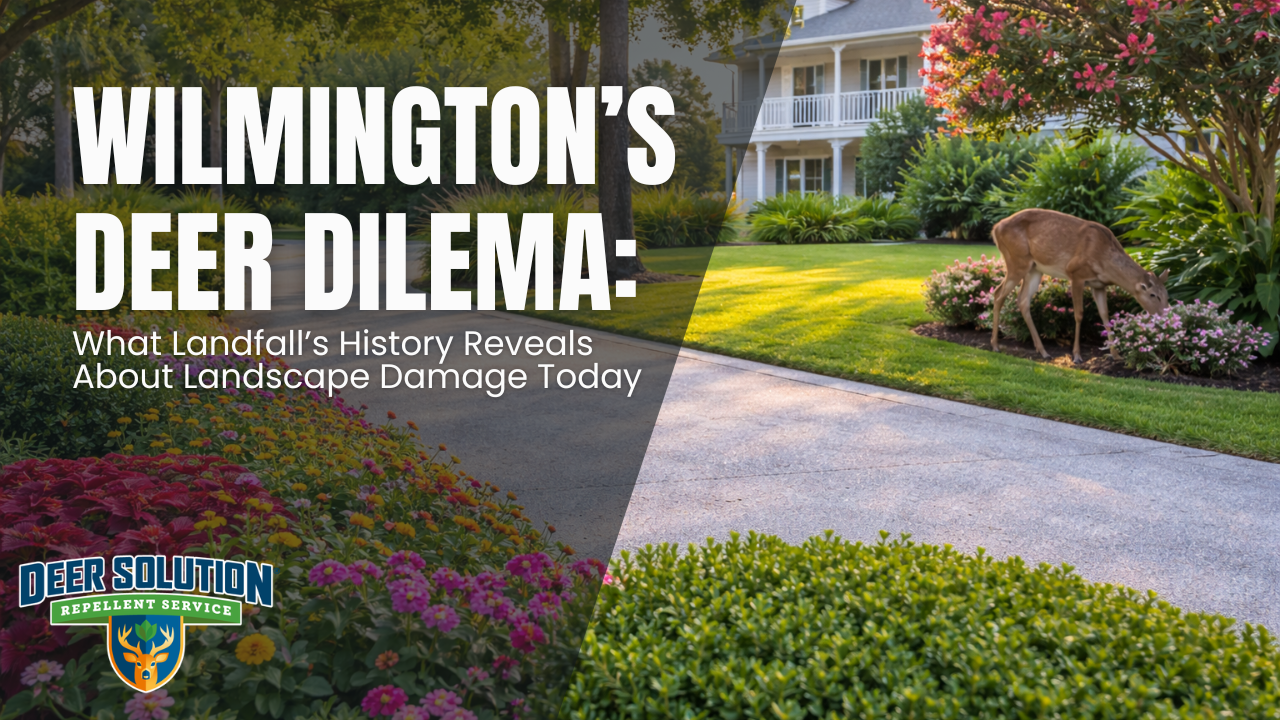
In Wilmington, North Carolina, deer have long been part of the natural landscape. But for homeowners, especially in communities like Landfall, that relationship has not always been easy.
A look back at the mid-1990s reveals something important. At that time, areas like Landfall, a large, private residential community known for its preserved natural spaces and upscale homes, began allowing more controlled deer hunting in response to growing deer populations.
Why? Because even then, the balance between people, landscaping, and wildlife was starting to tip.
A Familiar Pattern, Repeating Itself
Fast forward to today, and the same pressures are showing up again across Wilmington and coastal North Carolina.
North Carolina is home to roughly one million white-tailed deer, and populations continue to grow in suburban and coastal areas where hunting is limited or restricted.
Communities like Landfall were designed to blend luxury living with natural surroundings. But those same wooded buffers, golf courses, and landscaped properties create ideal habitat for deer. Without natural predators or consistent population control, deer adapt quickly and settle in.
The result is something many Wilmington homeowners are seeing firsthand:
- Shrubs browsed overnight
- Seasonal plantings disappearing
- Expensive landscaping struggling to establish
This is not new. It is a continuation of a decades-long trend.
Why Hunting Alone Isn’t a Long-Term Solution
The decision in the 1990s to allow more hunting in areas like Landfall highlights an important truth: population control can help, but it does not eliminate deer pressure, especially in residential settings.
In modern Wilmington neighborhoods, hunting is often:
- Restricted for safety reasons
- Logistically difficult in dense communities
- Inconsistent year to year
Even when populations are reduced regionally, deer behavior does not change overnight. The remaining deer continue to feed, and often concentrate in the safest, most protected environments, which tend to be residential properties.
That means the burden shifts from population control to property-level protection.
What This Means for Wilmington Homeowners
For homeowners investing in their landscaping, the takeaway is clear:
Deer pressure in Wilmington is not temporary. It is structural.
The same conditions that led to management efforts in the 1990s still exist today, but with more development, more ornamental plantings, and more limitations on traditional control methods.
That is why more homeowners are turning to proactive solutions that focus on protecting their specific property, rather than relying on broader population control efforts.
Protecting What You’ve Built
Deer do not recognize property lines, investment, or design intent. They respond to food availability and safety.
A professionally applied deer repellent program works by making your landscape less desirable compared to surrounding areas, helping reduce browsing pressure over time.
While no solution can promise that deer will never enter a property, consistent treatment can play a critical role in protecting plant material and preserving the look and value of your landscape.
The Bottom Line
Wilmington’s deer challenges are not new. Communities like Landfall have been navigating them for decades.
What has changed is the environment. More homes, more landscaping, and fewer practical options for population control mean that today’s homeowners need a different approach.
Understanding that history is the first step. Taking action to protect your property is the next.